Should I Stop Eating Meat? Part VII
Photo by Jan Huber on Unsplash
Part of a series. Part VI here.
Lots about food so far. What about food…waste?
I’ve left this to the end not because it doesn’t matter, but more because it does. Everything previously included is kind of framed like a choice — you must forgo something enjoyable in order to improve your environmental credzzz. But this one doesn’t really fall into that realm — I haven’t met anyone who takes great pleasure in tossing food out, not just because of the knowledge that 820m people suffer from malnutrition, but also because it’s the closest you can get to chucking cash in the bin.
Most of what has been looked at above there are people arguing for or against certain things — whether or not to include methane in animal’s footprint (the answer is it doesn’t matter), whether to use GWP or GWP*, how to properly conduct a LCA analysis for the transport sector. But when it comes to food waste no one that I’m aware of is screaming and shouting for more of it. So in trusting human nature this must mean:
- either we can’t control it — either as consumers or that retail waste is natural due to supply chain difficulties
- we can control it, but if it were to be plotted on the above graph of impacts it wouldn’t matter
Neither of these is true.
Food waste is not our problem m8, it’s the supermarkets
Before looking at the data behind this, it’s worth looking at whether or not the incentive structure of supermarkets makes sense for this. Supermarkets sell food for money. If that food is wasted, then they lose that money. Their whole job is to make as much money as possible from selling food. Given the choice of:
- finding some way to sell the same carrot for more when another supermarket down the road has the same original price
- stop effectively throwing their own products in the bin
it would seem obvious that they would choose the latter. And they do. We’ll get to the countless journals and pieces in the literature that back this up but for now let’s just work some stuff out ourselves like we’re trying to impress in some consultancy interview:
- there are around 66 million people in the UK, around 75% of which are >20, but those <20 also consume food — so all in let’s call it 85%-ish of 66 or lower bound it at 50 million
- how much food does a person eat in a day in terms of weight? I don’t think 1kg seems too off if we make it 3x meals of 330g
- all in then we have the UK population eating 50million * 1kg * 365days = 18,250 million kg of food each year
And how much do supermarkets waste? If we take this article then we get whopped in the headline that they collectively threw out an outrageous 190m meals a year. They put a meal at around 410g (backs up our assumption) so that makes 80,000 tonnes of food waste so 80 million kg per year of waste.
So that gives us as a % of what they sell supermarkets are wasting… (80 / 18,250) = 0.44%. Obviously we’ve assumed we get all our meals from the supermarket (and a few other things in there) but that doesn’t change the ballpark figure. As expected they are very good at selling their food for money instead of throwing it in the bin and because there’s lots of money on the line to grind that number lower they employee some very clever people to continually improve it.
It doesn’t change the picture that food waste is terrible and should always be minimised, just that perhaps:
- large supermarkets are an easy target for investigative journalism
- it’s easy to snap pictures of lots of food going to waste for an emotive thumbnail at a supermarket rather than in one of our own fridges
So whose (who’s??? never understood this one) the culprit?
It turns out we are. According to this paper published in April consumers are by far and away the main culprits in the UK. And it’s not just this paper, there are loads of them for other developed countries that establish roughly the same setup. In the developed world, consumers are responsible for around 45–50% of food waste with retail making up around 10% in comparison. To see this numerically we can look at this graph put together by WRI using data from the FAO in 2011 (WRI report here) to see how food waste varies geographically throughout the supply chain.
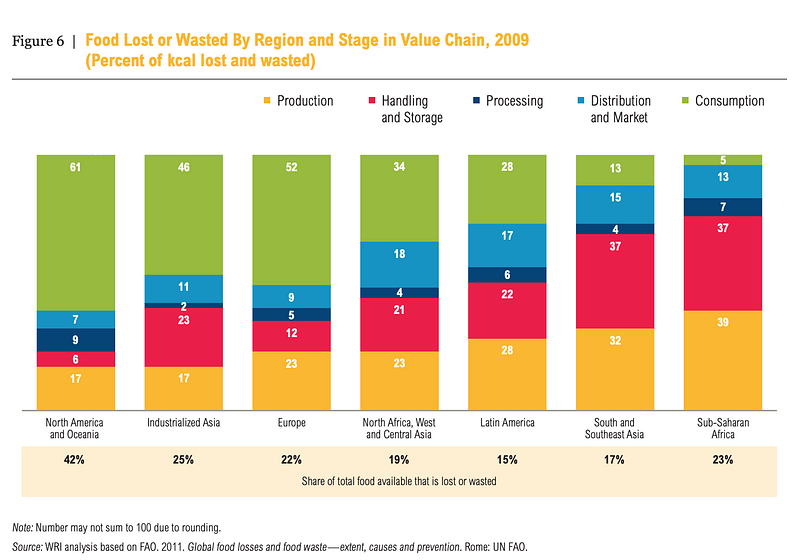
Image by UN FAO
So we see some consistency here. In the developed world, food waste is mostly a problem of consumers not eating all the food they are buying whereas in more developing areas more food is lost on the way to being retailed. But let’s go back to the original question.
How does food waste compare to dietary change?
Just like everything else — it depends on your diet and it depends on how much you waste but we can use our previously calculated numbers to help guide us:
- MBL highlights that diet makes up around 1/4 of an individual’s footprint (which in the UK is around 14,000 kg)
- this gives us 3,500kg for an annual diet footprint
- wasting a steak has a higher footprint than a carrot but for now let’s just assume when we waste food we waste it evenly throughout our diet
So how much do we waste? If we take the FAO’s estimate for North America and Europe of around 100kg each per year, then quite a lot. Based on our previous assumption of 365kg each per year that’s around 27% (so slightly worse than the supermarkets). But let’s add in a few different levels to aide comparison.
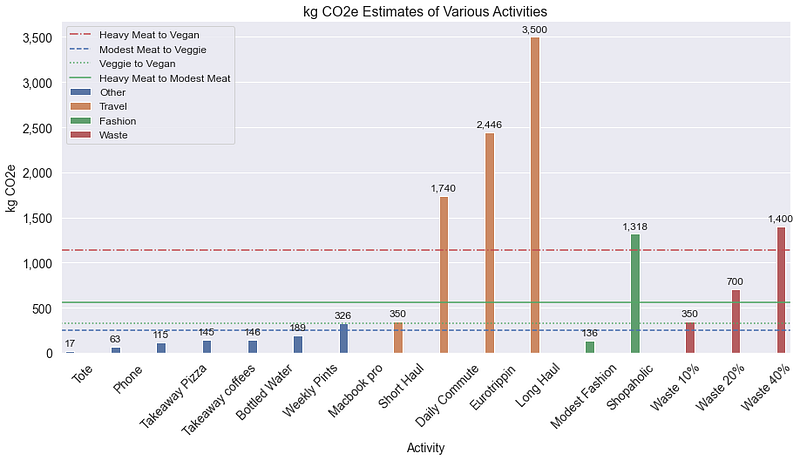
Image by author
So depending on how wasteful you are — it can be the most important thing by far. Even if you manage to cut your food waste from wasting 30% of food to 10%, that has a bigger impact than going from a ‘Heavy Meat’ diet to a ‘Modest Meat’ diet. And this is probably an under-estimate.
“It’s fine, it’ll biodegrade” was something I was used to hearing as a kid — it’s not that troubling to leave an apple core in a forest because it’ll rot and decay into the forest floor. But that’s not the case for most food waste. It will rot. Probably anaerobically in landfill. Producing methane as it goes. So not only do we waste the energy embedded in making our food, it then produces even more GHG on the other end once we waste it.
If it’s such a big issue why isn’t it seen as a big solution to climate change?
It is. It’s just not necessarily one that we hear about much. Probably it’s the skeptic in me but I’d argue that we don’t hear about it much because you can’t sell it. Many of the solutions that we’re pitched to climate change usually come with a product attached to them — tote bags, reusable cups, plant-based burgers. Looking at the above, the main solutions seem to be:
- eating a simple unprocessed diet of fruit, veg, high-protein beans and legumes
- wasting less food
- overall consuming less / only what we need to
but it’s quite hard to make money pitching the idea that red kidney beans are a solution to climate change or that you should eat all the food you buy. Despite that, reducing food waste is recognised as a big solution to climate change.
They’ve been mentioned throughout but not that much, but Project Drawdown have it ranked as potentially the number 1 solution to climate change. They’ve looked at solutions across all areas from agriculture to industry, emissions to sinks and created an estimated ranking of solutions to achieve ‘drawdown’ — the point where we start sinking more GHG than we emit. They have 2 scenarios — optimistic and less optimistic — with reduced food waste coming out 3rd and 1st respectively (3rd in optimistic as wind turbines and improved solar panels pip it in the optimistic scenario). But we can also cross-ref this with what we saw at the beginning — both PN2018 and also Crippa et al. (2021) put food waste at around 6–8% of global GHG emissions. Even reducing this by half (which is what PD’s less optimistic scenario assumes — technical note here) would cut 4% of emissions all without having to forgo anything. What more could you want?
Wrap it up please
Yeah this has been a long old waffle. Nice to do the full round trip and understand things a bit better.